Multi-Modal Endpoints
Overview
Beyond text-based chat completions, Apinizer AI Gateway supports four additional modalities, plus an alternative endpoint shape for text generation itself:
- Speech to Text (STT) —
/v1/audio/transcriptions - Text to Speech (TTS) —
/v1/audio/speech - Image Generation —
/v1/images/generations - Embeddings —
/v1/embeddings - Responses API —
/v1/responses
All five endpoints use the OpenAI-compatible request/response format; your existing OpenAI SDK clients work without code changes beyond pointing base_url at Apinizer. Every one of them goes through the same gateway pipeline as chat completions — token/USD quotas, cost tracking, and guardrails such as PII masking all apply.
Speech to Text (STT)
Transcribes an audio file into text:
from openai import OpenAI

client = OpenAI(
    api_key="your-apinizer-credential-key",
    base_url="https://your-apinizer-gateway.com/api/ai/v1"
)

with open("recording.mp3", "rb") as audio_file:
    transcript = client.audio.transcriptions.create(
        model="whisper-1",
        file=audio_file
    )

print(transcript.text)
- The request is sent as multipart/form-data
- Usage is metered based on audio duration, rather than token count
- The response text can be passed through the existing PII masking policy — personal data detected in the transcript is masked using the same rules as other text endpoints
Text to Speech (TTS)
Converts text into speech; the response is returned as a binary audio stream:
response = client.audio.speech.create(
    model="tts-1",
    voice="alloy",
    input="Hello, this is a test message."
)

response.stream_to_file("output.mp3")
The TTS response is not JSON, but an audio file (binary) returned directly — the gateway passes this response type through transparently, preserving the content type.
Image Generation
Generates an image from a text prompt:
response = client.images.generate(
    model="gpt-image-1",
    prompt="Sunset over the ocean, digital art",
    n=1,
    size="1024x1024"
)

print(response.data[0].url)
Embeddings
Converts text into a vector representation — the same interface used by Knowledge Bases, RAG, and the Semantic Cache to store and search content in a Vector Database:
response = client.embeddings.create(
    model="text-embedding-3-small",
    input="The quick brown fox jumps over the lazy dog."
)

print(response.data[0].embedding)
Usage is metered on input tokens only — an embedding call has no output token cost. Before routing a request, Apinizer checks that the target model actually supports embeddings, so a request can't accidentally be sent to a chat-only model.
Responses API
/v1/responses is OpenAI's newer, alternative shape for text generation — the same underlying capability as chat completions, with a different request/response envelope: an input field instead of messages[], and an output[] array instead of choices[].
response = client.responses.create(
    model="gpt-4o",
    input="Tell me a three-sentence bedtime story about a unicorn."
)

print(response.output_text)
Streaming works the same way as chat completions — pass stream=True and consume the returned event stream.
Provider Support
Only OpenAI-native providers speak the Responses API's wire format: OpenAI, Azure OpenAI, and Custom OpenAI-Compatible connections. Routing a Responses request to any other provider (Anthropic, Google Vertex/Gemini, AWS Bedrock, a self-hosted engine, and so on) returns HTTP 400 rather than silently falling back to a chat-shaped translation — several Responses-specific fields have no chat-completions equivalent, so a silent translation could quietly drop part of the request.
/v1/responses support in this release covers plain text generation, with the same quota, cost-tracking, and guardrail coverage as Chat Completions. Two things work differently for now:
- Tool calls — a Responses request that results in a function/tool call is returned to the client as-is; the gateway's automatic tool-calling loop (used with the MCP Gateway) currently runs only for Chat Completions requests.
- Structured-prompt features — Prompt Decorator, Prompt Template, Topic Guard, RAG injection, and the semantic cache's similarity match all read the standard
messages[]array. Since a Responses request carriesinputinstead, Prompt Decorator and Prompt Template currently pass such a request through unaffected, while Topic Guard, RAG, and the semantic cache fall back to scanning the request's raw text rather than parsing it message-by-message.
Pricing and Usage Metrics
The additional modalities are integrated into the existing AI Cost Settings and Reports infrastructure:
| Modality | Pricing Unit | Usage Metric |
|---|---|---|
| STT (whisper) | Per minute | Audio duration (seconds/minutes) |
| TTS | Per character | Input character count |
| Image generation | Per image (by size) | Number of images generated |
| Embeddings | Per 1M input tokens | Input token count |
These metrics are visible in Reports and Analytics alongside other LLM models, broken down by person/team/model.
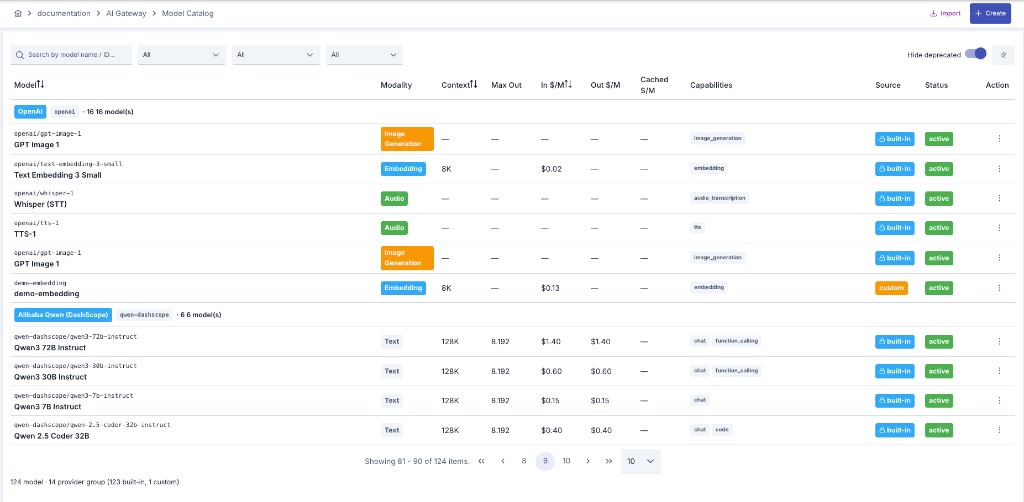
New models (such as whisper, TTS, and gpt-image) ship with pre-configured prices in the catalog; you can customize model pricing from the AI Cost Settings page if needed.
Endpoint Routing
The gateway automatically recognizes the target path of the incoming request (/v1/chat/completions, /v1/audio/transcriptions, /v1/audio/speech, /v1/images/generations, /v1/embeddings, /v1/responses) and routes it to the modality-specific processing pipeline (including binary response support, multipart parsing, and duration-based usage calculation) — no additional configuration is required, and all modalities can be served through the same AI Gateway.