API Plan and Rate Limit Control List (RLCL) Comparison
The Rate Limit Control List compared here was retired in 2026.09 and its screen was removed in 2026.09.3. Its role is now played by Limit Plans and assignments, and a portal Subscription Plan references a platform-scope Limit Plan directly. The comparison is kept for the reasoning behind the two models.
Two important concepts in API management—API (Product) Plan and Rate Limit Control List (RLCL)—serve different purposes but are complementary. In this article we examine the main differences between these two constructs and discuss when each is more appropriate.

What Is API (Product) Plan?
API Product Plan is a strategic business model that lets you package, price, and market your API services. It allows businesses to position their APIs as a product and offer structured service levels suited to different user segments.
API Product Plan typically includes:
- Usage quotas (daily/monthly total request count)
- List of accessible endpoints/resources
- Pricing structure (free, basic, premium, etc.)
- Support levels
- SLA (Service Level Agreement) guarantees
- Scaling features
What Is Rate Limit Control List (RLCL)?
RLCL is a technical mechanism developed by Apinizer to control the flow of API requests. Essentially, it consists of rules that define how many requests a given user or client can make in a given time window. RLCL offers an innovative approach that combines the classic Access Control List (ACL) concept with rate limiting.
RLCL especially includes:
- Per-user/client request limits (on a per-second/minute/hour basis)
- Targeted limit definitions (by IP, API key, user ID, etc.)
- Time window types (fixed or sliding)
- Flexible target audience targeting with operator-based conditions (equals, contains, starts with, etc.)
- Flexible execution order (can run at six different points in the request processing flow)
- Differentiated handling of out-of-target identities (block or apply a shared or per-identity general quota)
- Custom error message templates with variables (per error or plan-wide)
- Response behavior when limits are exceeded
For detailed information about RLCL configuration and features, see the Rate Limit Control List admin guide.
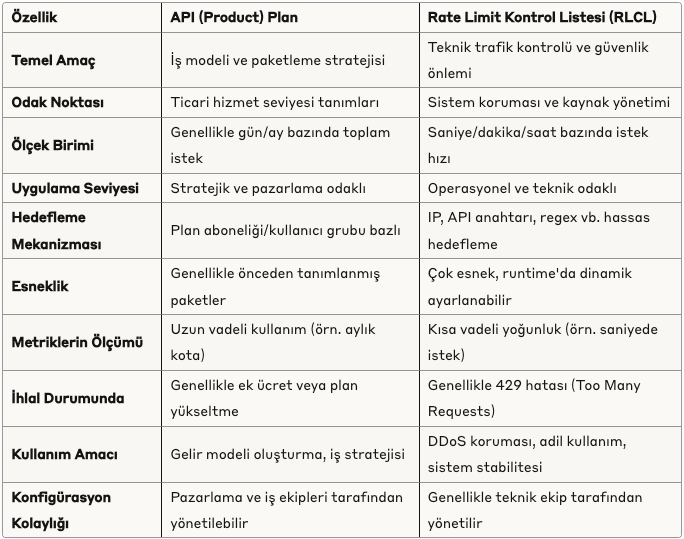
Key Differences Between API Plan and RLCL
When to Use Which?
Use API (Product) Plan When:
- You want to market your API as a product
- You want to define different service levels for different user segments
- You want to structure your revenue model
- You want to do customer segmentation
- For long-term usage planning
Use RLCL When:
- You want to ensure system security and stability
- You want to control sudden traffic spikes
- You want to prevent abuse
- You want to define highly customized limits for specific users or IPs
- You need more precise and flexible technical controls
How to Use Both Together?
API Product Plan and RLCL are not competitors but complements. Below are benefits and examples of using both together:
Layered Protection: With API Plan you set overall quotas, while with RLCL you control instantaneous load.
Flexible Business Model:
- API Plan: "Premium users can make 1 million requests per month"
- RLCL: "But no user can exceed 100 requests per second"
Security and Business Integration:
- API Plan defines the main framework for the business model
- RLCL ensures security and system stability within that framework
Flexibility for Special Cases:
- API Plan: "Under normal conditions, the same plan for all users"
- RLCL: "Customized limits by geography, IP, or behavior patterns"
Example Scenario: E-commerce API
Consider an e-commerce platform:
API Product Plan Structure:
- Free Tier: 1,000 requests per day, product info read-only
- Basic Tier: 10,000 requests per day, product info + stock queries
- Premium Tier: 100,000 requests per day, access to all endpoints
- Enterprise: Unlimited requests, dedicated support
RLCL Structure:
- All users: Maximum 20 requests per second
- Suspicious IP blocks (starting with
123.45.): Maximum 5 requests per second - Premium customers: Maximum 50 requests per second, but 30 outside business hours
- Special partners (starting with
API-XYZ-): Maximum 100 requests per second
In this setup, API Plan defines the business model and general access rules, while RLCL provides technical system stability and security.
Using Both Solutions with Apinizer
Apinizer offers both solutions as a strong platform that covers both the commercial and technical dimensions of API management:
Apinizer API Portal with API Product Plan:
- Apinizer's API Portal product lets you structure your APIs as a product
- You can create customized plans for different consumer segments
- You can define usage quotas, pricing models, and access rights
- You can offer self-service subscription and API key management
- With Developer Portal you can document and market your APIs
Apinizer Gateway with RLCL:
- Apinizer Gateway delivers the RLCL solution in an integrated way
- It provides a powerful mechanism for targeted, flexible rate limiting
- It improves API security and system stability
- It provides real-time traffic control to prevent abuse
The Apinizer platform integrates these two approaches seamlessly, allowing you to manage both the commercial and technical aspects of your API strategy under one roof.
Conclusion
API Product Plan and Rate Limit Control List (RLCL) address different but complementary aspects of API management. While API Plan shapes the commercial and strategic dimension of the business, RLCL provides technical operational control and security. In an ideal API management strategy, both approaches should be used in a way that complements each other with their respective strengths.
The Apinizer platform offers strong API Product Plan capabilities through its API Portal product while also providing the RLCL solution through its Gateway product, delivering a complete API management experience. This way both business and technical teams can meet their needs on the same platform.
Apinizer's RLCL solution goes beyond the traditional API plan approach to offer a more targeted, flexible, and powerful control mechanism. It is designed not to replace API plans but to complement and strengthen them.
Evaluating both of Apinizer's solutions to meet both business and technical requirements in your modern API strategy will help you achieve optimal results.