The Way We Manage APIs Is How We Should Manage LLMs
This is the first part of the Apinizer AI Gateway series. The goal is not a setup walkthrough; it is to answer this first:
Why does an AI Gateway exist, what problem does it solve, and where does it diverge from a classic API Gateway?
- What is an AI Gateway and why does it matter? (this part)
- AI Gateway in Apinizer: shared governance, separated runtime, components
- Hands-on scenario: answering with your own data via RAG
In enterprise software, managing APIs through a single door has long been the job of the API Gateway. Authentication, quotas, logs, routing, security policies… A familiar order.
Then LLMs arrived. Applications no longer talk only to REST endpoints; they talk to OpenAI, Anthropic, Azure, Bedrock, Ollama, vLLM. Multiple models at once, streaming responses, token-based cost, prompt-injection risk, answers grounded in company documents…
At that point a classic API Gateway alone is not enough. The layer that emerges is called an AI Gateway.
In later parts we will cover where it sits in Apinizer and a practical RAG scenario.
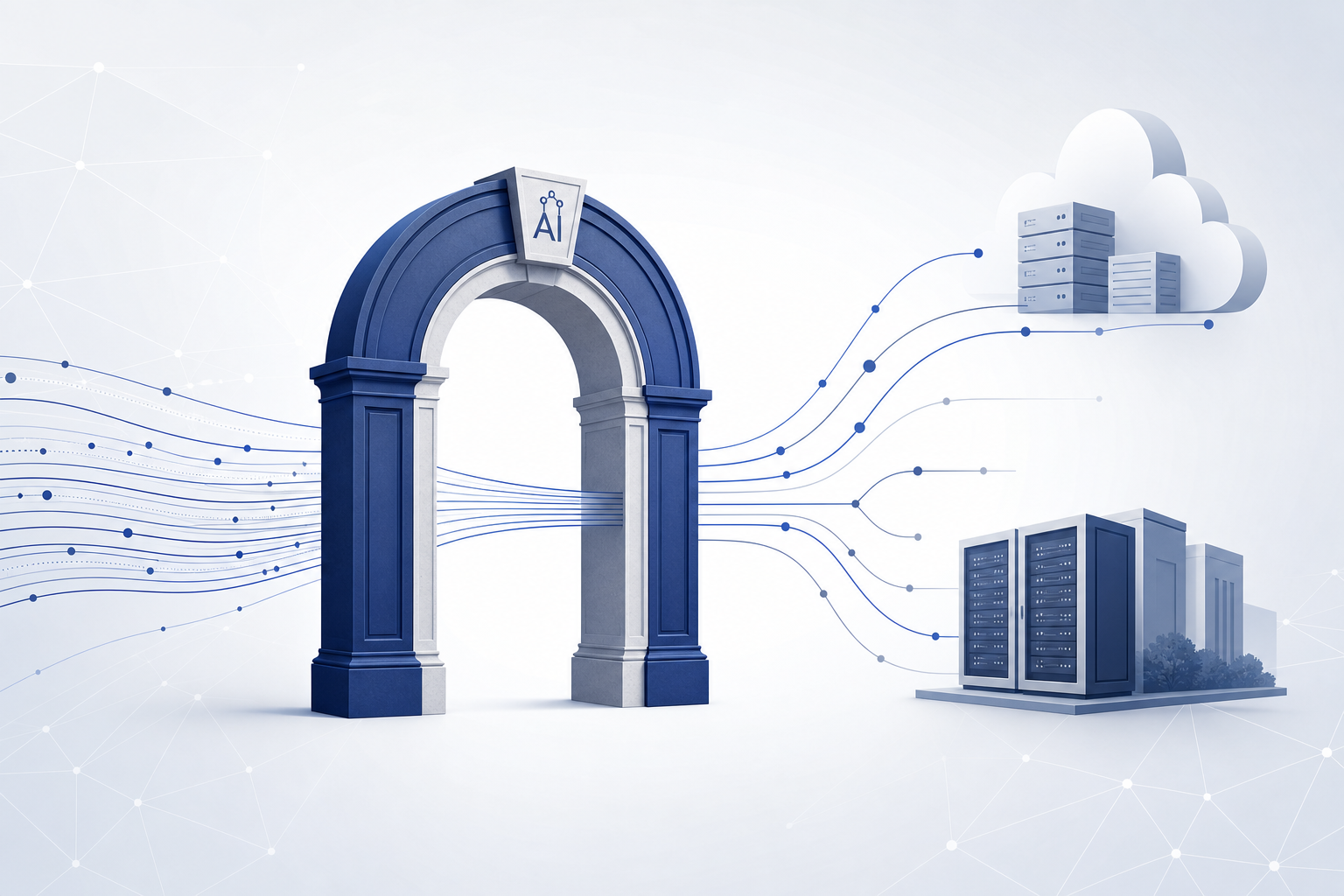
Short answer: what is an AI Gateway?
An AI Gateway is a control layer specialized for LLM traffic, sitting between your applications and large language model providers.
In practice, most AI Gateways — Apinizer included — expose an OpenAI-compatible interface to the client. You speak the same SDK / same request format; the gateway routes the call to the right provider and normalizes the response into a common format.
So you do not have to write a separate integration for every provider. One base_url, one identity model, many LLMs behind it.
But an AI Gateway is not merely a reverse proxy to an LLM. Its real value is centralizing controls that are specific to LLM calls:
- Model / provider routing and failover
- Token quotas and cost visibility
- AI guardrails such as prompt, PII, and DLP
- Semantic cache to cut redundant calls
- RAG for injecting enterprise context
- Monitoring, tracing, and usage analytics
The real enterprise question is not “does an AI Gateway exist?” It is where governance is attached. We will return to that with the Conway discussion shortly; the concrete Apinizer mapping comes in Part 2.
Why it matters: LLM traffic is not “just another API”
1) Provider and model changes break operations
Scene: a team starts with GPT. Cost rises, so they look at on-prem Ollama; regulation arrives, so they want Azure. Every time, client code, key handling, and error handling get rewritten.
With an AI Gateway, the application connects to the gateway; which model is used is managed centrally. When the provider changes, you do not reinvent the integration — routing and failover stay on the gateway side.
2) The real bill is not request count — it is tokens
Scene: at month-end, “API calls look low,” but the invoice is huge. Long prompts, bloated context, streaming output, and silent retries burned tokens. Which team burned which model is lost in a spreadsheet.
For classic APIs, TPS is often enough. For LLMs, visibility shifts to tokens, models, and cost. An AI Gateway makes that economy manageable with quotas, budgets, and usage signals — and makes “200 OK but from the wrong place / wrong model” observable too.
3) Security and correctness cannot be left to app code alone
Scene: a chatbot gets a company procedure pasted into the system prompt. Another team sends PII to the model unmasked. A third never considers prompt injection. The model invents a clause it does not know; everyone thinks “it works.”
With LLMs come prompt injection, PII leakage, off-topic use, and similar risks. Enterprise correctness also needs RAG: relevant context from your own documents before an answer is produced. An AI Gateway turns guardrails and RAG from a library reinvented in every app into a managed policy.
AI Gateway ≠ API Gateway (but not its enemy)
A comparison might look like this:
| API Gateway | AI Gateway | |
|---|---|---|
| Primary job | Manage API traffic | Manage LLM traffic |
| Typical target | REST/SOAP/gRPC services | LLM / embedding / agent protocols |
| Unit of concern | Requests, TPS, latency | Tokens, model, cost, context |
| Security | AuthN/Z, threat protection | + prompt/PII/DLP/topic guardrails |
| Enrichment | Header/body transforms | RAG, semantic cache |
| Success criteria | Reach the right service safely | Reach the right model, with the right context, under control |
The key point: a good AI Gateway does not “throw away” the API Gateway. In most enterprises, AI traffic should still live in the same lifecycle — project, deploy, policy, log, RBAC.
This debate is not new. In April 2025’s Gateway Zoo article, we wrote that endlessly bloating API Gateways with Event, Kafka, AI, and Agent Gateway concepts could recreate the ESB trap. The conclusion was clear: in large, long-lived systems, capabilities should be separate components connected by well-defined interfaces — but not everything should be piled into one runtime.
An AI Gateway does not violate that principle; done right, it applies it. What should be separated is runtime and responsibility boundaries. What should be unified is governance: identity, RBAC, policy, logs, deploy. The ESB trap is the collapse of the first — one runtime, business logic leaking in, an immovable monolith. Today’s trap is the fragmentation of the second: every AI tool bringing its own user management, its own log format, its own key store. One is called bloat; the other is shadow IT. The April article warned about the first; this article looks at the second. Not a contradiction — two ends of the same Conway tension.
This category is not empty. But many solutions in the field arrive as cloud-only subscriptions, or they stand up a second governance island next to the enterprise instead of attaching to its existing identity, policy, and audit plane. A separate runtime is not a flaw; inventing a second world of users, permissions, and logs is. That is the real choice.
How does a typical AI Gateway request flow?
Conceptually:
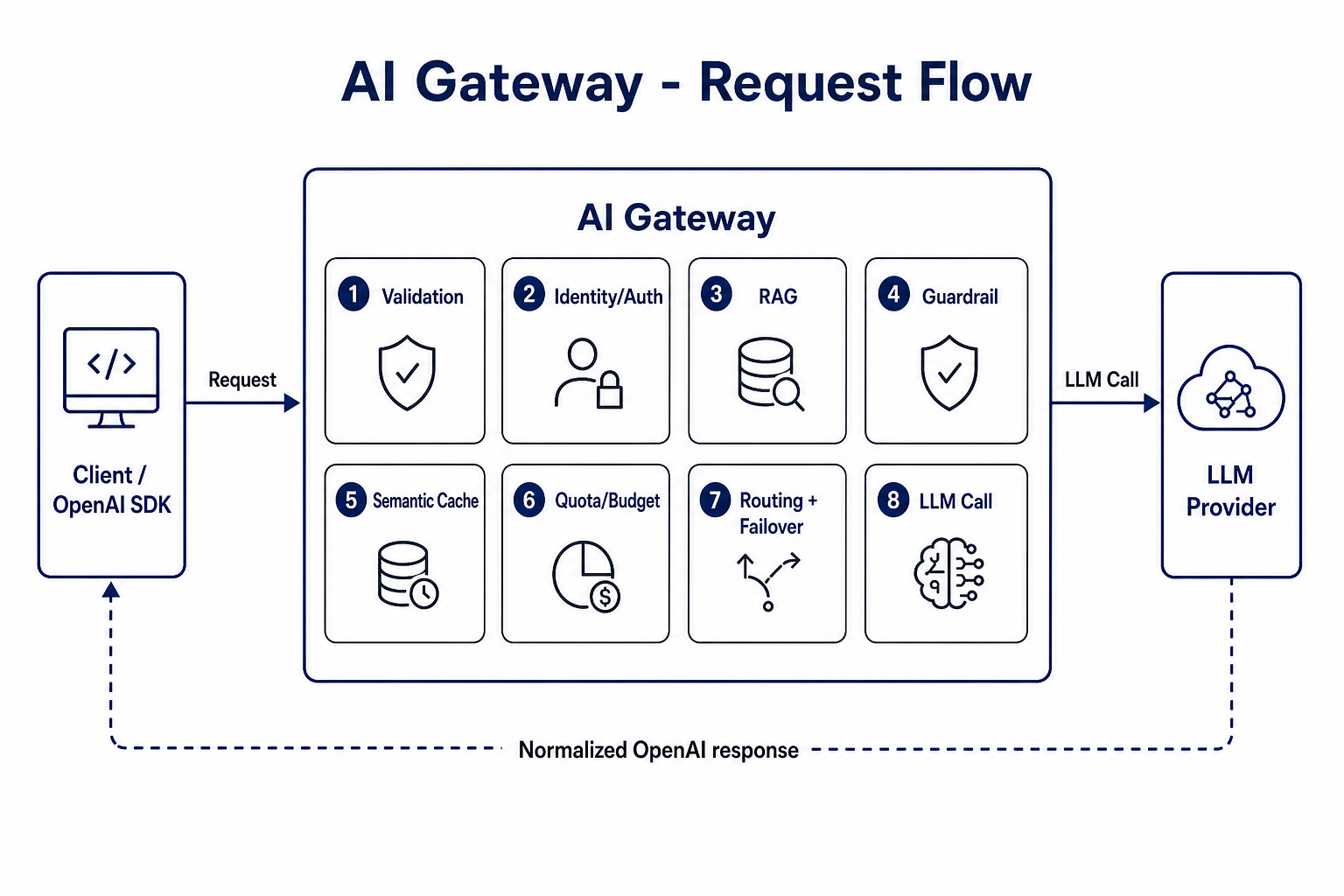
The product mapping for each step (which policy, which setting) belongs to Part 2. For now, three points are enough to hold the flow:
- RAG comes first. The enriched request that will reach the model is built first; guardrails and the cache key then operate on that enriched content. The reverse order can let poisoned context bypass scanning or produce the wrong cache match. A good AI Gateway enforces this order at runtime as well.
- Quota asks “how many tokens / which budget,” not “how many requests.” On overflow, the call is blocked or shifted to a cheaper model — product detail later.
- Failover walks to the next provider when the primary fails. The client keeps speaking the same OpenAI format.
A chat model and an embedding model are not the same thing
A distinction that will keep coming up in later scenarios:
- A chat / completion model produces answers.
- An embedding model turns text into a numeric vector.
In RAG they work together:
- Document chunks are embedded into vectors
- They are stored in a vector DB
- The user question is embedded too
- Similar chunks are retrieved
- The chat model answers with that context
Using one in place of the other is one of the most common technical reasons behind “AI is broken” complaints.
What happens without an AI Gateway?
In the short term everything can look “fine”:
- The app calls OpenAI directly
- API keys live in the frontend or in every service
- Quotas live in a spreadsheet
- Prompt rules differ by team
- Company documents are pasted into a chatbot system prompt
In the medium term the picture becomes:
- Key leakage and shadow IT
- Uncontrolled cost
- Integrations that break on model change
- Unauditable data egress
- The same problem solved again in every application
The promise of an AI Gateway is simple: make LLM access an enterprise capability — the same way we started managing APIs with an API Gateway.
Where this series goes next
In the next article we will talk about Apinizer specifically:
- How runtime and the governance plane are separated (and why that is different from the ESB trap)
- LLM Provider, Vector DB, Knowledge Base, AI Routing
- Where RAG Injection, semantic cache, token quotas, and guardrails sit in the product
- The concrete product-architecture counterpart of the Conway argument
Closing
An AI Gateway is not a fashion label; it is the name of a control need that appears when LLMs enter enterprise systems.
A classic API Gateway says “reach the right service safely.”
An AI Gateway says “reach the right model, with the right context, under the right control.”
In the April 2025 article, Agent Gateway was still a possibility. Roughly fifteen months later, the category is on the table — real. That article warned against the ESB trap; this series follows the other end of the same line — keeping governance from fragmenting.
In Part 2 we will map this frame onto Apinizer’s concrete components.