API Endpoint Creation Report
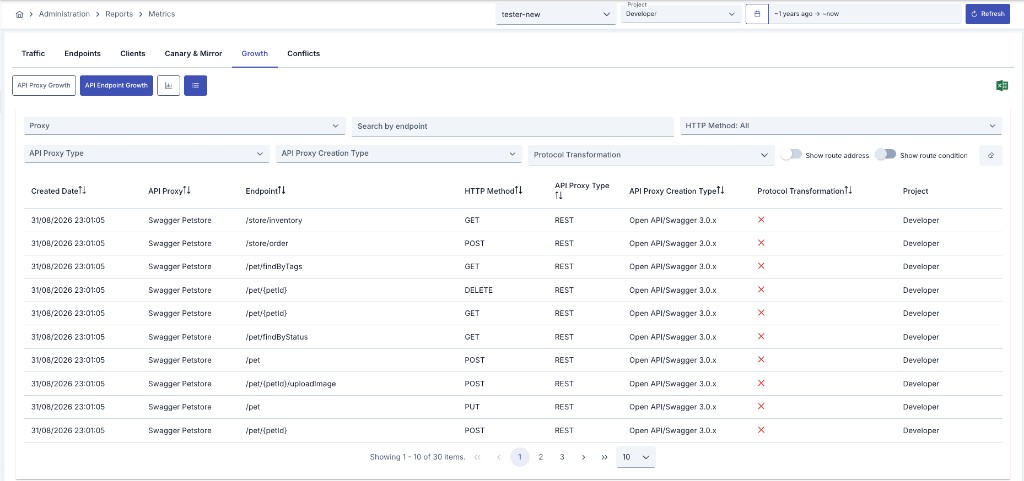
This report does not use Elasticsearch traffic data; it lists endpoint metadata (creation date, HTTP method, linked API Proxy information) from MongoDB. The Environment selector on the Metrics filter row does not filter this report.
This report does not show its own date picker; the creation window comes from the shared date range at the top of the Metrics page. When the API Growth or Endpoint Growth tab is opened for the first time, the window automatically widens to the last year if the shared range has not been changed manually.
Metrics Page
This report is the Endpoint Growth tab of the Metrics page (full name: API Endpoint Growth). Open it via Administration > Reports > Metrics or Reports > Metrics in the project menu.
The API Growth tab is related; see Proxy Creation Report for proxy creation metrics.
View Options
Use the chart/list buttons on the sub-report row to switch views:
Shows endpoint counts in the selected creation range as a vertical bar chart bucketed by Interval (Daily / Weekly / Monthly). Default interval is Monthly.
Lists created endpoints in a paginated table with proxy name, path, HTTP method, and spec information per row.
Filtering
Shared filter (Metrics top row)
| Option | Description |
|---|---|
| Environment | Applies to traffic reports; does not filter this report's list |
| Project | (Administration only) Limits creation records to selected projects |
| Date Range | Applied to endpoint createdDate; ES date-math is mapped to yyyy-MM-dd creation bounds |
| Refresh | Re-queries the active sub-report with the selected filters |
| Excel Export | Exports according to the active view: chart uses project + date only; list applies all list filters below. ZIP filename: apinizer-api-endpoint-report.zip |
List view filters
| Option | Description |
|---|---|
| Proxy | Narrows the list to selected API Proxies |
| Search by endpoint | Text search on the endpoint path |
| HTTP Method: All | GET, POST, PUT, DELETE, PATCH, HEAD, OPTIONS, TRACE, QUERY — multi-select |
| API Proxy Type | REST, SOAP, gRPC — multi-select; all endpoint-capable types when empty |
| API Proxy Creation Type | WSDL, Swagger 2.x, Open API/Swagger 3.0.x, Reverse Proxy, No-Spec API, DB-2-API, Mock API, Script-2-API, Connector |
| Protocol Transformation | Exist / Not Exist |
| Show route address | Adds routing target addresses to the table (default: off) |
| Show route condition | Adds condition summaries when route address is enabled (default: off) |
| Clear | Resets report-specific filters; project scope and shared date range are preserved |
Table Column Descriptions
| Column | Description |
|---|---|
| Created Date | Endpoint creation timestamp (dd/MM/yyyy HH:mm:ss) |
| API Proxy | Name of the API Proxy the endpoint belongs to |
| Endpoint | Method path (e.g. path portion of GET /pet/findByStatus) |
| HTTP Method | HTTP method (GET, POST, PUT, DELETE, etc.) |
| API Proxy Type | Type of the linked proxy (REST, SOAP, gRPC) |
| API Proxy Creation Type | Proxy creation source (Open API/Swagger 3.0.x, WSDL, etc.) |
| Protocol Transformation | Green check when protocol transformation exists; red X when it does not |
| Project | (Administration only) Project the endpoint belongs to |
When route toggles are enabled, additional columns appear: Route Address, Route Condition (condition is available only when route address is on).
Pagination options: 10, 25, 50, 100 rows.
Filtering by API Proxy Type
The API Proxy Type filter in list view offers the types that can define endpoints: REST, SOAP, and gRPC. AI, MCP, A2A, and WebSocket proxies do not contain endpoint definitions, so they are not listed in this report and are not offered as filter options. Multiple types can be selected at once; when none is selected, all endpoint-capable types are listed.
The API Proxy Type column shows the linked proxy type on every row, independently of the filter.
Showing Routing Information
Two options in the filter row show where your endpoints route requests. Both are off by default; when enabled, a new column is added to both the on-screen list and the Excel output.
Shows the target address a request to the endpoint is forwarded to. If the endpoint defines its own backend path, that path is appended to the address. Multiple targets are listed one under another.
When a target is used only if certain conditions are met, shows a summary on the same line as the address. The cell stays empty for targets without conditions.
The route condition option is available once route address is enabled. Condition summaries are aligned with address lines, so they carry no meaning without the address column.
An endpoint-specific backend path is appended to the address only for REST API Proxies. For other types, the target information defined at API Proxy level is shown as it is.
Because route columns are off by default, scripts that process your existing Excel output are unaffected; the columns appear only when you enable them.