Database Provider
Accessible and manageable by roles that have the "Manage Authentication Services" permission such as "Project Owner".
1) Identity Authentication Connection with Database
An image containing connection settings for identity authentication with database is shown below:
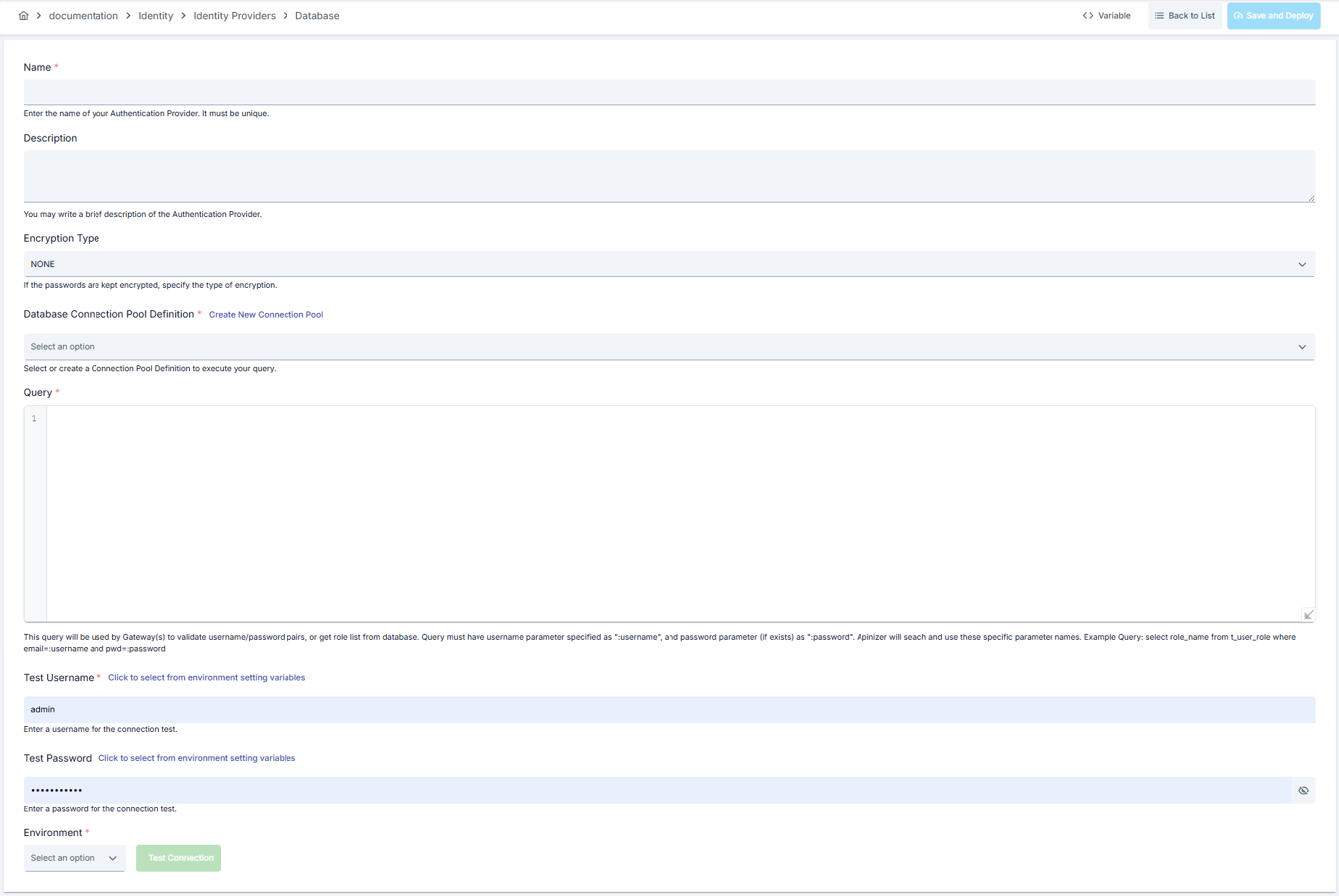
The fields used in connection settings for identity authentication with database are shown in the table below.
| Field | Description |
|---|---|
| Name | Name information of the created Database Identity Provider. |
| Description | A description can be written to facilitate management related to the created Identity Provider. |
| Encryption Type (Encryption Type) | If password information is stored encrypted in the table to be used in the database connection, the encryption type of the password stored in the table must be selected. Options: NONE, MD2, MD5, SHA1, SHA224, SHA256, SHA384, SHA512, Blowfish, RC2, RC4, AES CBC NoPadding, AES CBC PKCS5Padding, AES ECB NoPadding, AES ECB PKCS5Padding, AES GCM NoPadding, AES CFB NoPadding, AES CFB PKCS5Padding, AES OFB NoPadding, AES OFB PKCS5Padding, AES CTR NoPadding, AES CTR PKCS5Padding, DES CBC NoPadding, DES CBC PKCS5Padding, DES ECB NoPadding, DES ECB PKCS5Padding, DESede CBC NoPadding, DESede CBC PKCS5Padding, DESede ECB NoPadding, DESede ECB PKCS5Padding |
| Database Connection Pool Definition (Database Connection Pool Definition) | The pool from which the database connection will be obtained is selected or created. |
| Query (Query) | A query is used to get username/password pairs or role list from the database. In the query, the username parameter should be defined as ":username" and if there is a password parameter, it should be defined as ":password". Apinizer works with these special parameter names. Example query: select role_name from t_user_role where email=:username and pwd=:password |
| Test Username (Test Username) | Enter the value that will be used instead of the username parameter when running the test query. You can select values from environment setting variables next to the field. |
| Test Password (Test Password) | Enter the value that will be used instead of the password parameter when running the test query. You can select values from environment setting variables next to the field. |
| Environment (Environment) | Select the environment for the Test Connection operation. This determines which environment variables are used in the test. |
| Variable Button (Variable) | You can select dynamic values for fields using the [<> Variable] button at the top of the page. For details, review Dynamic Variables. |
2) Identity Authorization Connection with Database
When performing identity authorization, the role field of the relevant user is obtained in the database query. This role field is later matched with the ROLES/GROUPS field in Authorization in the proxy policy.
Authorization uses the same Database Provider form; the query typically includes only the :username parameter. Example:
select role_name from t_user_role where email=:username
Synchronization
Using the Identity Synchronization Profile tab on the Database Provider edit screen, you can synchronize users from this source into Consumer records. For the fields shared with every source — enable/cron, deactivation mode, synchronization scope, and the reconciliation safety net — see Provider Synchronization. The tab's Synchronize Now button becomes available only after the provider has been saved once; it does not appear yet on the create screen.
User Query Columns
The User List Query is a parameterless SELECT statement. Apinizer reads its result by column alias, case-insensitively, so the query can name its own columns however the source needs and use AS to line them up with the aliases below.
| Alias | Required | Meaning |
|---|---|---|
username | Yes | Login name. If no username alias is present in the query result, the first column is used instead. A row with neither a username nor an e-mail is skipped. |
email | No | E-mail address. |
full_name (or fullname) | No | Full name. |
external_id | No | Stable identity at the source. Destructive operations stay off while it is empty — see Reconciliation Safety Net. |
enabled | No | Account state at the source. Recognized values (case-insensitive): true, 1, y, yes, t, active, enabled mean active; false, 0, n, no, f, inactive, disabled mean inactive. Anything else is taken as active and recorded as an issue — see Preview Issues below. |
organization_path | No | Organization path of the user, for example /Head Office/IT. |
organization_external_id | No | Stable identity of that organization. |
Organization List Query
An optional second query, Organization List Query, returns the organization tree to reconcile against. Leaving it empty is valid — the tree is then derived entirely from the organization_path values on the user rows.
| Alias | Required | Meaning |
|---|---|---|
path | Yes, once this query is configured | Full organization path. |
name | No | Display name. The last path segment is used when it is empty. |
external_id | No | Stable identity of the organization. |
parent_path | No | Path of the parent organization. It is derived from path when empty. |
The examples below use PostgreSQL syntax — only the column aliases matter, not the SQL dialect.
SELECT login AS username, mail AS email, display_name AS full_name,
       emp_no AS external_id, status AS enabled, dept_path AS organization_path
FROM users;

SELECT unit_path AS path, unit_name AS name, unit_code AS external_id, parent_unit_path AS parent_path
FROM units;
What Can Go Wrong
| Situation | Result |
|---|---|
organization_path is not one of the query's columns | The field is never read; a synchronized user keeps the organization it already has. |
organization_path is present but blank on a row | That user is linked to no organization, and the run records a diagnostic. |
external_id is present but blank on some rows | For those rows the stable identity is treated as missing; the run falls back to matching by user name for them, so renaming a user in the source looks like a removal. |
An enabled value is not recognized | The account is taken as active, and the run records a diagnostic. |
organization_path uses a backslash instead of a forward slash, or is malformed otherwise | The path is treated as malformed; write it with / as the separator. |
Connection Test and Source Preview
Alongside the existing Test Connection button (above, using Test Username/Test Password/Environment), the provider's edit screen offers three more diagnostic tools. All three work against the query and connection currently entered in the form, and none of them writes anything.
| Action | What it does |
|---|---|
| Test connection (step by step) | Measures the connection in 9 separate steps and shows each one on its own row — see Connection Test Step Matrix. |
| Preview | Reads the first rows the User List Query (and, if configured, the Organization List Query) would return — see Source Preview. |
| Explain | Walks a single username through the same steps synchronization itself takes, and shows the outcome of each — see Explain User. |
All three send requests, from the Manager, using the connection and queries currently entered in the form — they therefore require the "Manage Authentication Services" permission, the same as saving the provider.
Connection Test Step Matrix
Test connection (step by step) opens a Connection Test dialog. Each step is measured separately, so you can see exactly where the connection breaks. If a step fails, every step after it is reported as Not applicable.
| # | Step |
|---|---|
| 1 | Configuration Check |
| 2 | Connection Pool |
| 3 | Database Connection |
| 4 | User Query |
| 5 | Column Contract |
| 6 | Account State Values |
| 7 | Organization Path |
| 8 | Organization List Query |
| 9 | Sample Rows |
The result table shows, for each step, its status (Succeeded, Failed, Not applicable, or Unsupported), duration, an explanation, and — when relevant — the HTTP status, a provider code, a suggestion, and a technical detail.
Source Preview
Preview opens a Source Preview dialog. This preview runs the user query and reads the first rows; it creates, updates, and deactivates nothing.
- The number of rows read is capped at 200.
- Turning on Dry run reads every page and reports what a synchronization run would change, still without writing anything.
- Results are shown on three tabs: Users, Organizations, Issues.
- The Users tab shows, per row: User Name, Full Name, E-mail, Stable Identity, Account State, Organization Path, and Resolved Organization.
- The Organizations tab shows, per row: Path, Name, Source Code, Source (From list or Derived), and Users.
With Dry run on, a Dry Run Difference box also reports Users read/Organizations read, and how many records would be created, updated, deactivated, unlinked, reactivated, or would skip (a row whose user name is already registered under another project — see DB-I11 below). Reactivated counts a consumer that synchronization previously disabled because it disappeared from the source and that has since reappeared — this behavior is the same on every source and never touches a consumer disabled by hand, see Behavior and Safety Notes. If the list was read only in part, the would-deactivate counts are reported as zero rather than the real number, to avoid suggesting a mass deactivation that has not actually been checked.
Preview Issues
The Issues tab lists one row per rule the preview's data raised, with a code, a severity, and a finding; some rows also carry a one-click Apply fix.
| Code | Severity | Finding |
|---|---|---|
| DB-I00 | Error | The source could not be read at all — see the step-by-step connection test. |
| DB-I01 | Warning | Row(s) with a blank username/email were skipped. |
| DB-I02 | Warning | The same username is used by more than one row; only the first was created. |
| DB-I03 | Error | A configured column alias is not in the query result. |
| DB-I04 | Warning | Organization path(s) could not be read, for example because of a wrong separator. |
| DB-I05 | Warning | An organization path is not in the configured organization list; it was derived from the user row instead. |
| DB-I06 | Warning | An account state value was not recognized; the account was taken as active. |
| DB-I07 | Warning | The stable identity is blank on some rows. |
| DB-I09 | Info | An organization path matches a manually created organization; it was adopted and stays under manual management. |
| DB-I10 | Info | No organization contract is configured at all; only users are synchronized. |
| DB-I11 | Warning | The user name is already registered in another project, so no consumer is created for that row. Rename the user in the source, or move the existing consumer to this project. |
Explain User
Explain opens an Explain User dialog: enter a username to see step by step why a user is synchronized or not, across 7 steps.
| # | Step |
|---|---|
| 1 | Row Lookup |
| 2 | Raw Values |
| 3 | Organization Path |
| 4 | Organization Resolution |
| 5 | Account State |
| 6 | Stable Identity |
| 7 | Result |
Each step reports Success, Warning, Failed, Not applicable, or Skipped, together with an explanation and, where relevant, the values it read.